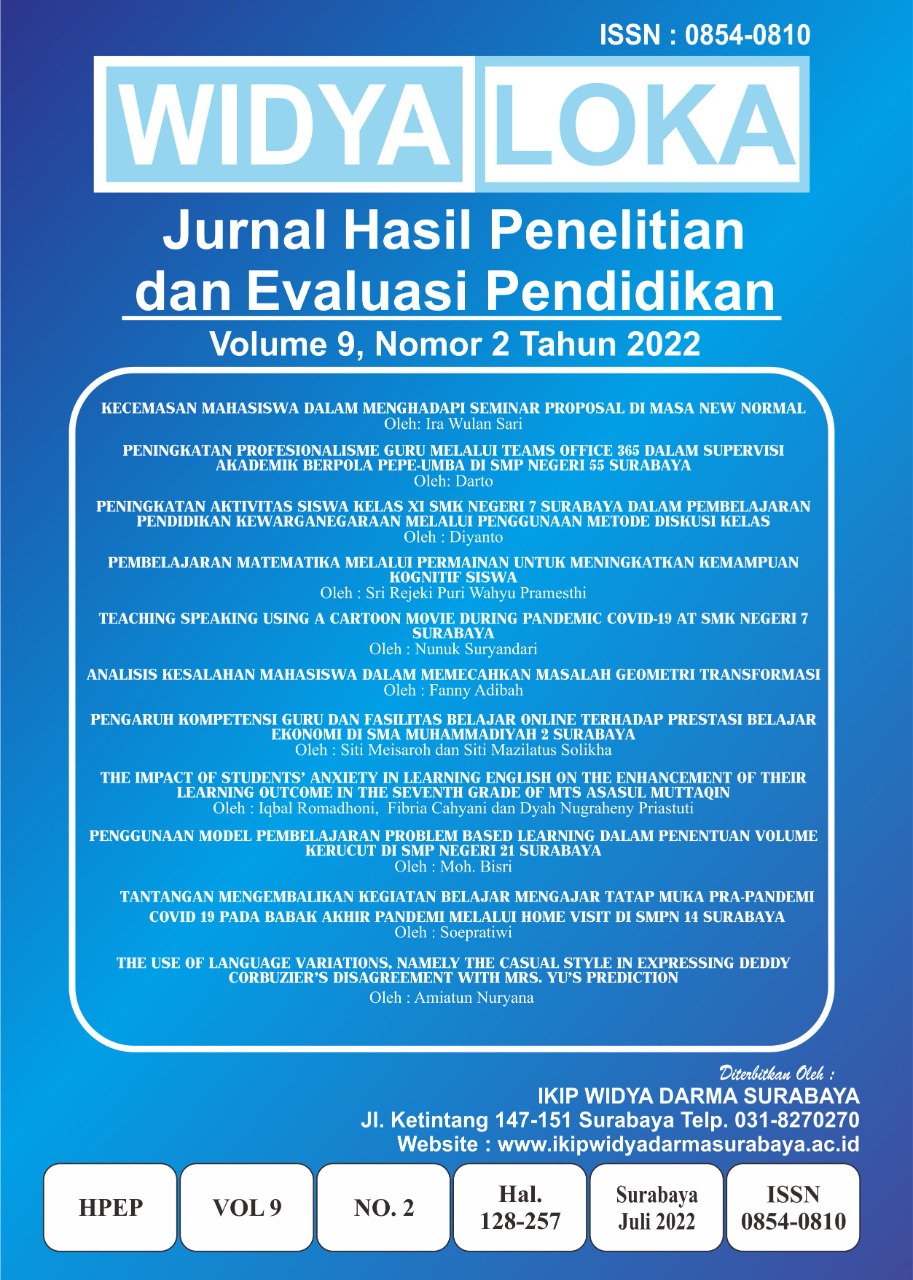
TEACHING SPEAKING USING A CARTOON MOVIE DURING PANDEMIC COVID-19 AT SMK NEGERI 7 SURABAYA
Keywords:
Cartoon Movie, Speaking SkillsAbstract
The COVID-19 pandemic in Indonesia has changed the online learning paradigm. There are many obstacles that teachers face while online—starting from the network and teaching media. Because if it is only taught with theory, it will feel boring. The author has tried to apply interesting learning using a cartoon movie in class X TKJ 1 at SMK Negeri 7 Surabaya. The academic year 2020/2021 by conducting classroom action research begins April 31, 2021, and ends May 9, 2021. This activity is carried out in 2 cycles consisting of planning, implementation, observation, and reflection. From cycle one activities, an average of 73 students' speaking skills increased in cycle 2 with an average value of 83, so this research is considered successful.
References
Arikunto, S,. et. al. (2008). Penelitian Tindakan Kelas, Jakarta: PT. Bumi Aksara.
Bao, W. (2020). COVID -19 and online teaching in higher education: A case study of Peking University. Human Behavior and Emerging Technologies, 2(2), . 113–115. doi:https://doi.org/10.1002/hbe2.191
Brazil, D. (1995). A Grammar of Speech. Oxford University Press
Brown, H. D. (2001). Teaching by Principles: An Interactive Approach to Language Pedagogy. (2ndEd.). New York: Pearson Education co.
Brown, H. D. (2004). Language Assessment: Principles and Classroom Practices. Essex: Pearson Education, Inc.
Brown, H. D. (1995). Teaching by Principles an Interactive Approach to Language Pedagogy. New Jersey: Prentice Hall Regents Englewood.
Brown, H.D. (1994). Teaching by principles: an interactive approach to language pedagogy. Englewood Cliffs, NJ: Prentice Hall Regents.
Brown, J. B. (1997). Textbook evaluation form. The Language Teacher 21.10, 15–21
Brown, H. D. (2005). Principles of Language Learning and Teaching, Fourth Edition. New York: Pearson Education.
Burns, A. (1999). Collaborative Action Research for English Language Teachers: Cambridge: Cambridge University Press.
Crystal, D. (2003). English as a global language, second edition. Cambridge: Cambridge University Press.
Gilbert, M. (2009). Using Movies for Teaching Low Level Student in English:English Teaching Forum Vol.31 July-September
Hammond, J. (1992). English for social purposes: A handbook for teachers of adult literacy. Sydney, Australia: National Centre for English Language Teaching and Research.
Harmer, J. (2007). The Practice of English Language Teaching 4thEd. Oxford: Pearson Longman.
Manser, Martin H.(1991). Oxford Learner’s pocked Dictionary. New York: Oxford University Press.
Martinez, Flor Alicia., Esther Uso-Juan. (2006). Current Trends in the Development and Teaching of the Four Language Skills (Studies on Language Acquisition). Walter de Gruyter Gmbtl. & Co. KG., p.139
Michael Wallace. (1998). “Downsizing the American Dream: Corporate Restructuring, Work and Family at Century’s End.” In Dana Vannoy & Paula Dubeck (eds.), Challenges for Work and Family in the 21st Century. Hawthorne, NY: Aldine de Gruyter.
Munjayanah, Anik. (2004). The Implementation of Communicative Language Teachind Speaking at LIA.
Nunan, D. (Ed). (2003). Practical English Language Teaching. Singapore: The McGraw-Hill Companies.
Rahman, M. H., Uddin, M. S., & Dey, A. (2021). Investigating the mediating role of online learning motivation in the COVID-19 pandemic situation in Bangladesh. Journal of Computer Assisted Learning, 1-15. doi:10.1111/jcal.12535
Sadiman, A. (et.al). (2010). Media Pendidikan. Jakarta: Raja Grapindo Persada.
Downloads
Published
How to Cite
Issue
Section
License
Copyright (c) 2022 NUNUK SURYANDARI

This work is licensed under a Creative Commons Attribution-ShareAlike 4.0 International License.