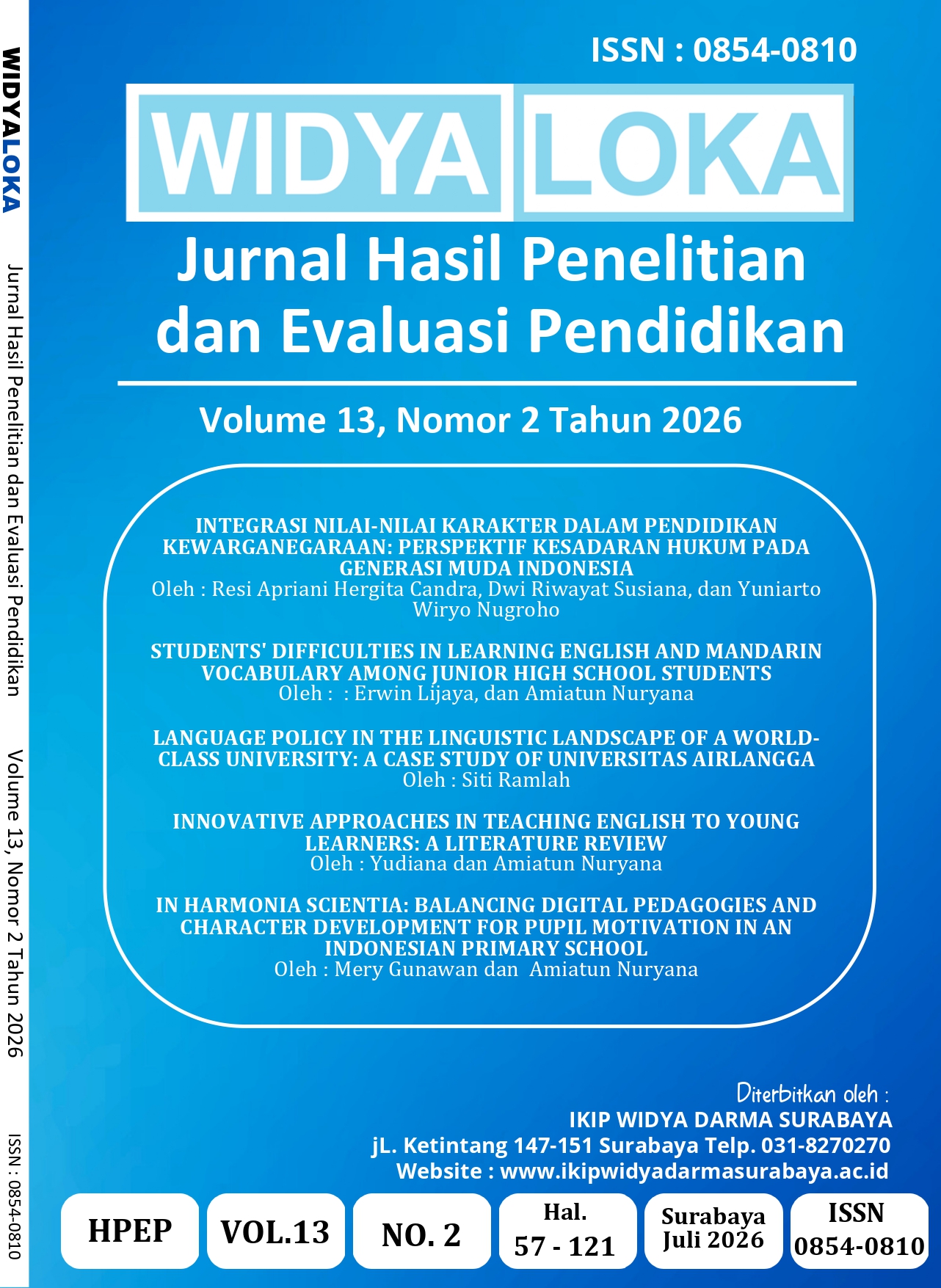
INNOVATIVE APPROACHES IN TEACHING ENGLISH TO YOUNG LEARNERS: A LITERATURE REVIEW
Keywords:
Innovative Learning Methods, English Language Teaching, Young Learners, Technology-Assisted Learning, Student Engagement.Abstract
This literature review examines the impact of innovative learning methods on teaching English to young learners. In many educational environments, conventional teaching approaches are often less effective in maintaining students’ interest and active participation. Therefore, more creative and interactive teaching strategies are needed to support meaningful learning experiences.This study applies a literature review approach by examining various academic sources, including journal articles, books, and previous studies related to innovative teaching practices in English language instruction. The review focuses on several approaches, including game-based learning, technology-assisted learning, and collaborative learning. The analysis reveals that innovative teaching methods positively influence students’ motivation, participation, and understanding of English. These approaches encourage learners to become more active in classroom activities while creating a more enjoyable and supportive learning atmosphere. In summary, innovative learning methods contribute significantly to improving the quality of English teaching for young learners. Teachers are encouraged to adopt these approaches to create effective, engaging, and student-centered learning environments.
References
Anderson, T. (2008). The theory and practice of online learning. Athabasca University Press.
Brown, H. D. (2001). Teaching by principles: An interactive approach to language pedagogy (2nd ed.). Longman.
Cameron, L. (2001). Teaching languages to young learners. Cambridge University Press.
Harmer, J. (2007). How to teach English. Longman.
Kessler, G. (2018). Technology and the future of language teaching. Foreign Language Annals, 51(1), 205–218.
Prensky, M. (2001). Digital game-based learning. McGraw-Hill.
Putri, N. A. (2021). Collaborative learning in improving students’ speaking
Richards, J. C., & Rodgers, T. S. (2001). Approaches and methods in language teaching (2nd ed.). Cambridge University Press.
Sari, D. P. (2019). The use of technology in English language teaching and learning. Indonesian Journal of English Education, 6(1), 45–56.
Slavin, R. E. (2015). Cooperative learning: Theory, research, and practice. Allyn & Bacon.
Wright, A., Betteridge, D., & Buckby, M. (2006). Games for language learning (3rd ed.). Cambridge University Press.
Yuliani, S., & Sujono, S. (2020). The effectiveness of game-based learning in teaching English vocabulary. Journal of English Language Teaching, 9(2), 123–130.
Downloads
Published
How to Cite
Issue
Section
License

This work is licensed under a Creative Commons Attribution-ShareAlike 4.0 International License.